
 UGC Infra
A Guide to Ad Creative AI for Marketing
Our guide explains how ad creative AI builds better campaigns. Learn to use AI to generate high-performing ads, saving you time and improving results.
Ad creative AI is a technology that automatically generates ad visuals and copy. It analyzes performance data to determine which designs, colors, and messages will connect with your specific audiences. This process gives marketing teams a significant advantage, letting them test many options without the usual manual work.
What Is Ad Creative AI and How It Works
Ad creative AI automates the process of making ad assets. Instead of a designer manually creating every banner, video, or piece of ad copy, you provide an AI platform with your core brand ingredients. This includes your logos, product shots, brand colors, and key marketing messages.
From there, the AI takes over. It mixes and matches these elements to generate hundreds or thousands of different ad variations. This approach shifts your workflow from slow, manual design cycles to rapid, automated production.
The Core Functions of Ad Creative AI
The technology works through a few key functions.
First is data analysis. The AI reviews large amounts of advertising performance data to find patterns. It learns what visual styles, headlines, and calls-to-action work best for certain audiences on specific platforms.
Next is creative generation. Using insights from its data analysis, the AI builds new ad creatives with the assets you provided. It experiments with numerous combinations of layouts, fonts, and images, all optimized for engagement.
These systems give AI the flexibility to pull, recombine, and adapt messaging to suit individual journeys. This allows you to meet customers where they are with messaging that will resonate with them.
Finally, most ad creative AI tools include performance prediction. They score the ads they generate, giving you a forecast of how well each one is likely to perform. This feature helps you prioritize which ads to test, saving you time and ad spend on concepts that would not have worked.
From Manual Design to Automated Production
The old way of making ads is slow. A marketer writes a brief, a designer creates a few concepts, and the team provides feedback. This process limits the number of ideas you can produce.
Ad creative AI changes that workflow. Your team’s role changes from producing individual ads to managing a system that produces them at scale. This allows your designers and marketers to focus on strategy and high-level creative concepts instead of repetitive tasks.
Your creative process becomes informed by data, not just intuition.
This new way of working provides serious benefits:
- Speed: You can get new ad variations ready for your campaigns in minutes, not days or weeks.
- Scale: You can produce enough creative to run targeted campaigns for all your different audience segments without overwhelming your team.
- Smarter Testing: With more variations, you can run more effective A/B tests to find what connects with your audience.
By bringing this technology into your workflow, your marketing becomes more agile. You can respond to market trends and test new ideas quickly, giving you an edge. The focus shifts to constant, data-driven improvement.
What You Gain by Using AI in Your Creative Workflow
Bringing AI into your ad creative process is a fundamental shift in how your team operates, and the benefits appear almost immediately. The most obvious gain is a large increase in efficiency. Your team can now generate hundreds of ad variations in the same amount of time it used to take to create a few. Production bottlenecks disappear.
This new speed means you can test more ideas, faster. Instead of waiting days for a new set of creatives, you can have them ready in minutes. That agility is valuable when you need to respond to a market trend or refresh a stale campaign.
Drive Better Campaign Performance
Speed is good, but performance is what matters. This is where AI excels. These tools are not just guessing. They analyze large amounts of performance data to determine which creative ingredients lead to conversions. This approach removes much of the guesswork from ad design.
AI platforms can predict which combinations of images, headlines, and calls-to-action will most likely resonate with a specific audience. You launch campaigns with ads that are already primed for success.
The performance lift comes from A/B testing on a scale that is not humanly possible. You can test dozens of creative concepts at the same time, quickly see what is working, and allocate your budget to the winners. This constant optimization loop leads to higher conversion rates and a better return on ad spend (ROAS).
AI-generated creatives have been shown to increase conversion rates by up to 14 times compared to traditional ads, which shows how effective this technology is for automating complex production.
Personalize Ads at Scale
Good advertising speaks directly to the individual. AI makes that a practical reality, not just a marketing buzzword. You can generate unique ad variations for different demographics, interests, or user behaviors without exhausting your design team.
For instance, you could serve different ads to new users versus loyal customers.
- For New Users: You might show ads that highlight an introductory offer or explain your app's core benefits.
- For Returning Customers: The creative could focus on new features they have not tried or special rewards for them.
This tailored messaging makes your ads feel more relevant, which is a huge factor in driving clicks and engagement. To get more ideas for building these kinds of strategies, check out our guide on modern marketing campaigns.
A good way to think about it is that AI breaks your campaign into reusable parts like headlines, images, and CTAs. Then, it can mix and match those components to create the perfect ad for each user at any point in their journey.
Reduce Creative Fatigue and Let Your Team Focus on Strategy
Creative fatigue kills campaigns. It is the point when your audience has seen the same ad so many times they ignore it, and performance drops. AI is the perfect solution. It gives you a constant stream of fresh, diverse creative so you can swap out old ads and keep your audience engaged.
By automating the production work, you also give your marketing team their time back. Instead of spending their days resizing images or making small tweaks to the same ad, they can focus on what they do best: big-picture strategy. They have more time for analyzing performance, brainstorming new concepts, and planning what is next.
Ad creative AI is like a powerful assistant. It handles the tedious production work, allowing your team to focus on the strategic thinking that grows the business. Your whole creative process becomes smarter and more effective.
How Ad Creative AI Platforms Operate
These platforms operate in a straightforward way. Think of an ad creative AI not as a blank canvas, but as a fast and talented junior designer who you need to brief first. The process is designed to take the manual work out of ad creation, and it starts with giving the AI your core brand materials.
The first step is to upload your essential brand assets. These are the fundamental building blocks the AI will use to construct every ad, ensuring everything looks and feels like it came from you.
Typically, you will provide:
- Logos: Your main logo, secondary versions, and any other variations.
- Color Palettes: The specific hex codes for your brand's official colors.
- Fonts: Your brand's unique typography.
- Product Images: High-quality shots of your product or key app screenshots.
Once these assets are loaded, the AI has a solid grasp of your brand's visual language. Getting this right is critical. The quality of what you put in directly affects the quality of what the AI produces.
Defining Your Message and Audience
With your visual identity locked in, the next step is to give the AI your strategic direction. You need to tell it what you want to say and who you want to reach. This is where you will input key messaging elements like headlines, body copy, and calls to action.
You also define your target audience inside the platform. You can specify demographics, user interests, and past behaviors, which helps the AI customize the creative to connect with that group. A headline that grabs a Gen Z user's attention is different from one that works for a Baby Boomer, and the AI uses this data to make smarter creative decisions.
This infographic breaks down how this kind of structured process leads to better time management, performance, and scale.
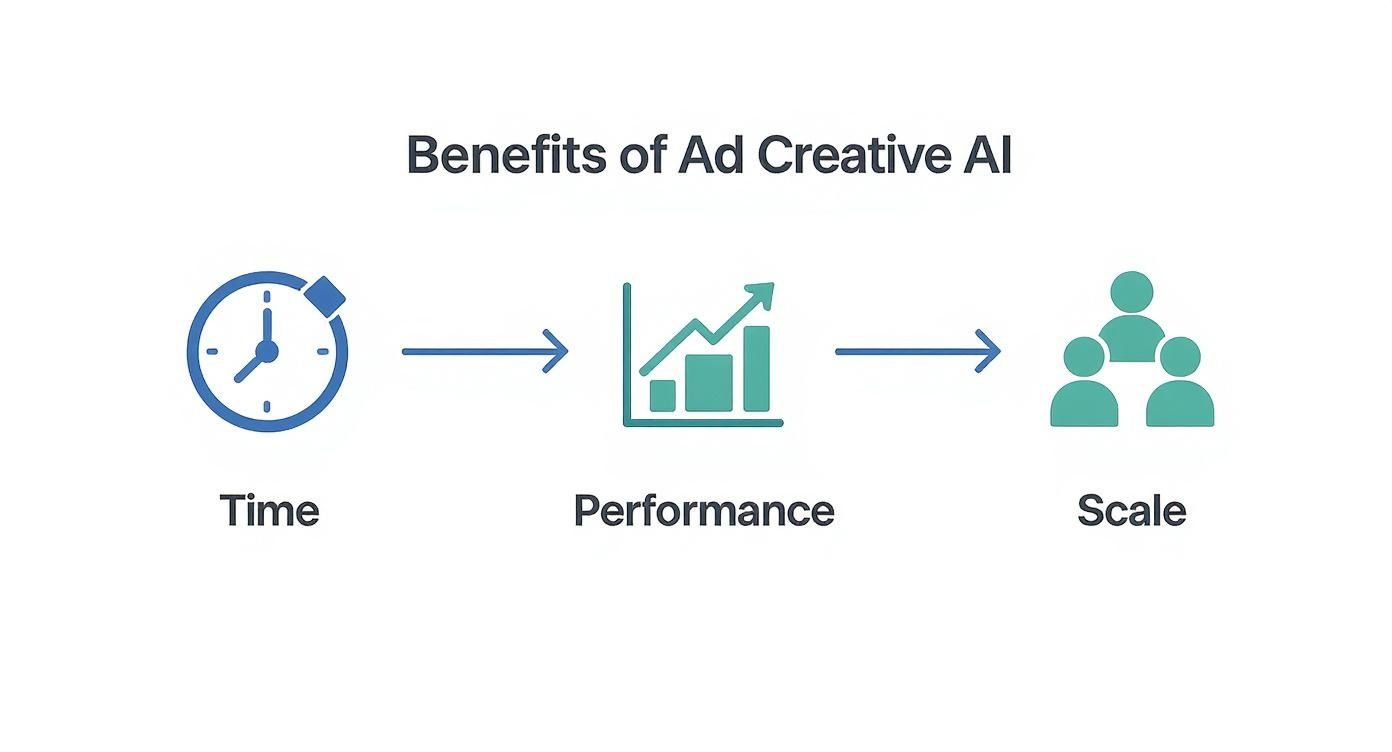
As you can see, by automating the initial, time-consuming parts of creative production, you allow your team to focus on the high-impact work of analyzing results and scaling what works.
The Typical Workflow in an Ad Creative AI Platform
To give you a clearer picture, here is a step-by-step look at what the process usually looks like.
This systematic approach takes you from a simple brief to a live, multi-variant campaign in a fraction of the time it would take a traditional creative team.
Generating and Launching Ad Variations
Once your assets and messaging are in the system, the platform's algorithm takes everything you have provided and cross-references it with a large dataset of historical ad performance. Then, in a matter of minutes, it generates hundreds of distinct ad variations.
The AI will play with different layouts, swap out images, test different color combinations, and rearrange headline placements. It runs thousands of small experiments to create a large portfolio of ads designed to appeal to different segments of your audience. This is where you feel the impact of automation. It produces a volume of creative that would take a human team weeks to attempt.
The core function of these platforms is to break your campaign into reusable components. The AI then systematically tests combinations of these parts to find the most effective ad for any given user.
Many of these platforms even score the generated ads based on predicted performance. This feature helps you immediately spot the variations most likely to be winners. You can see which ads are predicted to drive the most clicks and conversions before you spend a single dollar on media.
The final step is getting your campaigns live. Most ad creative AI platforms offer direct integrations with major ad networks like Meta, Google, and TikTok. This allows you to push your new ads directly from the AI tool to your ad accounts with a few clicks. It eliminates the tedious process of downloading and re-uploading assets for each network, making your entire marketing operation much more efficient.
Creating High-Impact Video Ads with AI
Video ads are necessary for grabbing attention, but traditional video production can drain your time and budget. This is exactly where AI ad creative tools are changing the process for marketing teams, making it faster and less complicated.
Today’s generative AI can create a compelling video ad from a simple text prompt, a single image, or an existing video you want to repurpose. The AI does the heavy lifting, giving you a high-quality video without needing a full production crew.
Automating the Production Workflow
Think of these AI platforms as your video production assistant. You feed them your core idea, and they build a complete video ad around it, handling all the technical parts that would normally require specialized skills and expensive software. This level of automation is a big win for any team trying to produce more video without burnout.
What can they do?
- Automated Voiceovers: Drop in a script, and the AI generates a natural-sounding voiceover. You can choose different languages and accents.
- Intelligent Music Selection: The AI finds and syncs royalty-free background music that fits the mood and pace of your ad.
- Dynamic Scene Transitions: AI creates smooth, professional transitions between scenes that keep your viewers engaged.
- Text and Caption Overlays: The platform can automatically generate and time captions or text overlays to emphasize your most important messages.
With these features, you can go from concept to a polished final cut in a fraction of the time.
Scale Your Video A/B Testing
This is where AI excels for performance marketers: large-scale testing. Manually creating dozens of video variations to test different hooks, visuals, or CTAs is usually not feasible. It is too slow and costly. AI removes that barrier.
Now, you can generate a full suite of video ad variations in minutes. This lets you systematically A/B test every critical element to find out what resonates with your audience.
Want to see which opening hook stops the scroll? Or test different visual sequences to see which one drives more clicks? AI makes it possible to do all of that and more.
This approach removes guesswork from creative strategy. Instead of hoping something works, you are making decisions based on performance data. The result is a cycle of constant improvement that leads to higher engagement and a better return on your ad spend.
Making High-Quality Video Accessible to Everyone
The rise of generative AI in advertising is reshaping the entire creation process. A recent report from the Interactive Advertising Bureau confirms this, showing that 86% of media buyers are already using or plan to use generative AI for their video creatives. This is especially beneficial for smaller businesses that can now create professional-grade video without a large price tag.
AI is also getting good at creating videos that feel authentic and user-generated. It can mimic that genuine, relatable style that audiences trust, giving you the credibility of real user videos combined with the scalability of AI. If you want to learn more about this concept, check out our guide on what is user-generated content.
AI has made scalable video ad production a reality for everyone. You no longer need a massive budget or a dedicated video team to create high-impact ads that drive results.
Getting the Most Out of Ad Creative AI

To get good results from your ad creative AI, you need to feed it high-quality ingredients. The platform is only as smart as the information you give it. So, always start by uploading your best brand assets. This means high-resolution logos, clean product shots, and your official brand color palette.
It is a simple "garbage in, garbage out" scenario. When the AI has crisp, professional assets to work with, it can generate ads that look polished and feel authentic to your brand. Getting this first step right is the foundation for building ads that connect with and earn the trust of your audience.
Give the AI Clear, Concise Direction
Once your visuals are loaded, you need to give the AI clear strategic guidance. This means writing sharp messaging prompts and defining your target audience with precision. The AI needs to know who you are talking to and what you want to say.
Vague instructions will get you generic, forgettable ads. You have to be specific with your headlines, body copy, and calls to action. For instance, instead of a bland "Buy Now" CTA, try prompting the AI with something more specific like "Download for Free Today" or "Claim Your 20% Discount." This clarity helps the AI generate more relevant and effective creative. If you are looking for a refresher, our complete guide to ad creative fundamentals is a good place to start.
This level of precision is becoming necessary as AI becomes more integrated into marketing. A recent study from Matic Digital found that 98% of marketing leaders now use AI to engage customers, with these tools helping 75% of companies increase engagement through automated ad buying, targeting, and content creation.
Embrace a Cycle of Testing and Iteration
Using an ad creative AI is not a one-time task. The value comes when you embrace a constant cycle of testing and iteration. Your goal should be to launch multiple ad variations, analyze the performance data, and then use those insights to steer the AI toward better results.
Keep a close eye on key metrics like click-through rate (CTR) and cost per acquisition (CPA). When you spot a variation that is outperforming the others, figure out why. Is it the headline? The image? The color scheme? Feed those winning elements back into the AI to inform your next round of ads.
Think of yourself as a creative director guiding a fast and talented designer. Your job is to interpret the data and provide strategic feedback, while the AI handles the rapid production of new creative.
This continuous feedback loop allows you to relentlessly fine-tune your campaigns for peak performance.
Balance Automation with a Human Gut Check
While the AI handles the heavy lifting of generation, human oversight is still essential. You should always review the AI-generated creatives before they go live. This final check ensures every ad aligns with your brand's voice, values, and overall strategy.
This human touch is your best defense for maintaining brand safety. A person can catch subtleties and nuances an AI might miss, preventing a potentially off-brand or awkward ad from reaching your audience. It is the critical last step in protecting your brand reputation.
Here is a simple checklist to keep you on track:
- Define a specific target audience for every campaign.
- Provide high-res brand assets and clear style guidelines.
- Write direct messaging prompts with specific calls to action.
- A/B test different creative elements constantly.
- Analyze the performance data to guide the AI’s next moves.
- Do a final human review for brand safety and alignment.
By following these steps, you get the speed and scale of AI, guided by the strategic wisdom of your marketing team.
Frequently Asked Questions About Ad Creative AI
As AI-powered creative tools become a fixture in the modern marketing toolkit, it is natural to have questions. You might wonder how it affects your creative team, what the budget implications are, or how it will work with the platforms you already use. Let us clear up some of the most common questions so you can make smarter decisions.
Will Ad Creative AI Replace Human Designers?
This is a big question, and the short answer is no. Think of ad creative AI not as a replacement for human designers, but as a powerful assistant that enhances their work. The strength of this technology is automating repetitive, time-consuming work.
Imagine the hours spent creating dozens of ad variations for A/B testing or resizing the same core asset for every ad placement. AI can complete those tasks in minutes, allowing your designers to focus on what they do best.
Ad Creative AI handles the high-volume, repetitive production work. Your designers provide the strategic thinking, the original idea, and the critical brand stewardship that no algorithm can replicate. The best results happen when you blend the strengths of both.
Your team can now direct their energy into higher-level strategy, brainstorming unique campaign concepts, and making sure every ad feels true to your brand's voice. Human creativity is still the essential ingredient for setting the initial artistic direction, interpreting nuanced performance data, and making final strategic calls.
How Much Does Ad Creative AI Cost?
There is no single price for ad creative AI. The cost depends on what you need, including the platform's features, the volume of ads you plan to generate, and how many people on your team will use it. Most providers use a monthly subscription model with different tiers to fit businesses of all sizes.
Here is a rough idea of what you can expect:
- Entry-Level Plans: For small businesses or solo marketers, these usually run between 30 to 100 per month. You will get basic generation features, often with a cap on the number of creatives you can produce.
- Mid-Tier Plans: Geared toward growing businesses and marketing teams, these plans typically fall in the 100 to 500 per month range. They come with more advanced features, higher output limits, and seats for multiple users.
- Enterprise Plans: Large companies with complex advertising operations will need custom-priced enterprise packages. These offer unlimited creative generation, deep integrations, dedicated support, and top-tier security.
When looking at the price, think about the return on your investment. A good platform should save your team time and improve your campaign performance. This often makes the subscription a good decision. The key is to assess your team’s actual needs and choose a plan that delivers real value.
Which Platforms Does Ad Creative AI Integrate With?
For any tool to be useful, it has to fit into your existing workflow. That is why most ad creative AI platforms are built to connect with the tools you already use every day. The most crucial integrations are with the major digital ad networks.
This direct link lets you push your new creatives straight to your ad accounts, streamlining your campaign launch process. You will almost always find integrations for:
- Meta Ads (for Facebook and Instagram campaigns)
- Google Ads (covering Search, Display, and YouTube)
- TikTok Ads
- Pinterest Ads
Connecting your accounts gets rid of the tedious process of downloading assets from one place to manually re-upload them to another. Beyond the ad networks, many AI tools also connect with other essential marketing software, like analytics platforms, project management tools (Asana or Trello), and collaboration hubs like Slack.
These connections, often powered by APIs, help you build a more unified marketing ecosystem. For instance, creative performance data can flow automatically into your analytics dashboard, letting you see the whole picture and optimize your campaigns much faster.
What Kind of Businesses Benefit the Most?
Almost any business advertising online can get a lift from ad creative AI, but a few types of companies see big benefits right away.
E-commerce brands, for instance, are a perfect fit. They often manage large product catalogs and need a constant stream of fresh ads for sales, seasonal campaigns, and retargeting. AI gives them the ability to create high-quality product ads at the scale they need to stay competitive.
Mobile app companies are another prime example. Driving app installs is all about constant creative testing to beat ad fatigue and find the visuals that attract high-value users. Ad creative AI lets them generate and test hundreds of variations in a fraction of the time, helping them reduce their cost per install.
Finally, marketing agencies live and breathe this work. They manage multiple clients, each with their own brand identity and campaign goals. AI tools empower them to produce a high volume of on-brand creative for everyone, all without hiring more designers. It is a large improvement to their efficiency and bottom line.
Ready to see how AI can transform your app's growth? Adworkly combines expert strategy with AI-powered tools to help you achieve viral success. Learn more about our services.