
 UGC Infra
A Modern Playbook for Mobile App User Acquisition
Level up your mobile app user acquisition strategy. This guide breaks down how to drive sustainable growth with a smart channel mix, ASO, and creative testing.
Mobile app user acquisition is how you get new, engaged people to install and use your app. This is not just about racking up downloads; that is a vanity metric. A real UA strategy is about finding high-quality users who will stick around, spend money, and become your biggest fans. To get there, you will need a smart mix of paid ads, organic growth, and creator-led campaigns.
Building Your User Acquisition Foundation
So many founders get this wrong. They jump straight into running ads, burn through their budget in a few weeks, and have nothing to show for it but a spike in downloads and a high churn rate. Do not be that founder.
Before you spend a single dollar, you need to build a solid foundation. This is the unsexy but absolutely critical work of figuring out the economics of your app. It means defining clear goals, knowing exactly what a user is worth to you, and having a crystal-clear picture of who you are trying to reach. Skipping this is like trying to build a house on sand.
The competition is no joke. With global app downloads projected to hit 255 billion by 2025, you are fighting for attention in a crowded market. The entire user acquisition industry is set to be worth around $55 billion by 2025, growing at a blistering pace of 18%. These are not just abstract numbers; they represent an enormous opportunity if you have a plan. You can read more about these mobile app marketing statistics to really grasp the scale.
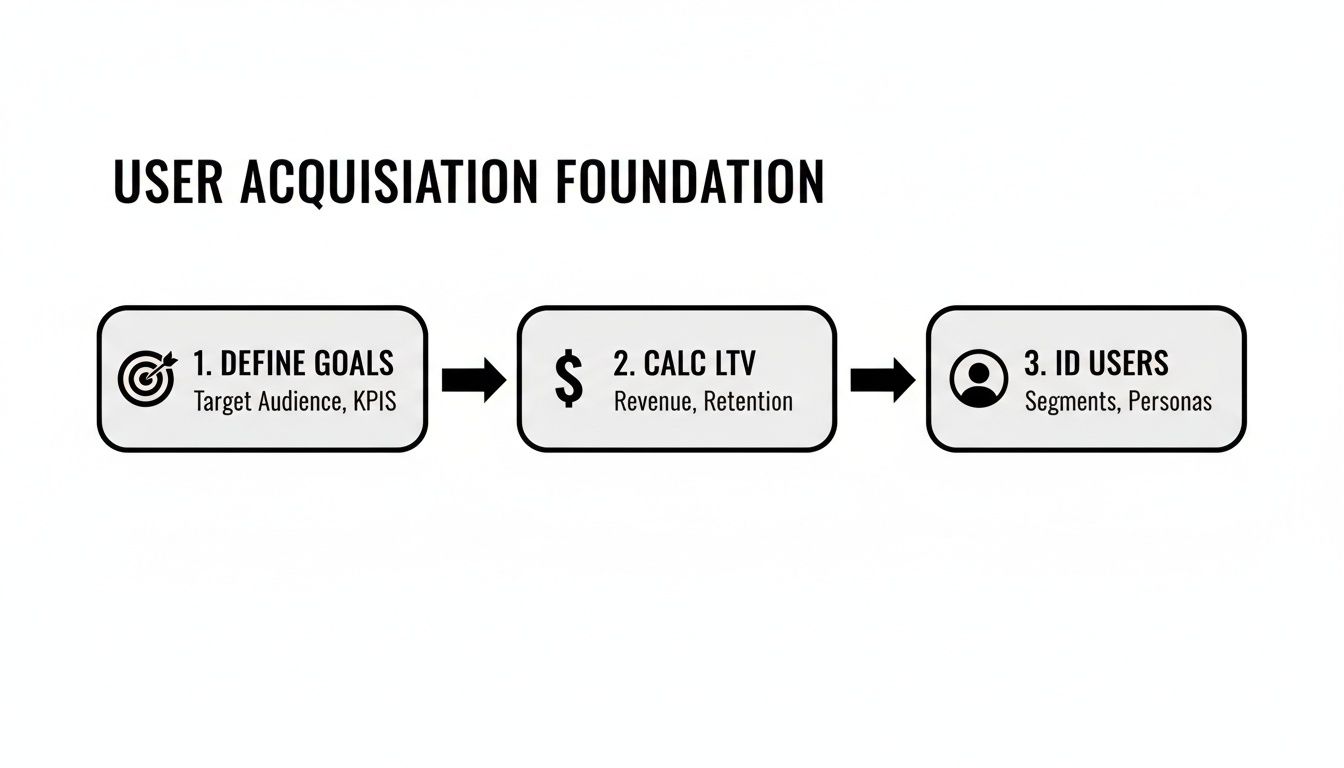
Defining Your Key Performance Indicators
First things first: what does "success" actually look like for your app? You need to define this in cold, hard numbers. Your Key Performance Indicators (KPIs) are the vital signs of your growth engine, telling you what is working and what is bleeding cash.
While there are dozens of metrics you could track, it is best to start with the essentials. Here are the core metrics every app founder must track to build a profitable user acquisition program.
Key User Acquisition Metrics and Their Purpose
Tracking these metrics is not optional. They are the bedrock of any successful UA program and will guide every decision you make.
The Power of Calculating Lifetime Value
If you only focus on one metric, make it Lifetime Value (LTV). Seriously.
LTV predicts the total profit you will make from an average customer over their entire relationship with your app. It answers the most fundamental question in the business: How much is a user actually worth?
Knowing your LTV is the difference between gambling on ads and building a predictable, profitable growth machine. It is the ceiling for your Cost Per Install.
You do not need a data science team to get started. A simple LTV calculation is a great first step. Just multiply your Average Revenue Per User (ARPU) by the average customer lifespan.
For example, if a user generates 5** per month on average and typically sticks around for **6** months, their LTV is **30. Simple, right? But now you have a magic number. You know you can spend up to $29.99 to acquire a user and still turn a profit. Without that number, every dollar you spend is a shot in the dark.
Finding Your Winning Channel Mix
A smart user acquisition strategy is not about being everywhere at once. It is about being in the right places, at the right time, with the right message. Real success comes from methodically building a diverse mix of channels that work together, creating a predictable flow of high-quality users.
This means you cannot put all your eggs in one basket. Relying solely on a single platform is a recipe for disaster; one algorithm change can tank your entire growth plan overnight. The key is to balance the immediate scale of paid advertising with the long-term, compounding value of organic growth and the raw authenticity of creator-led campaigns.
Paid Acquisition: The Heavy Hitters
Paid UA is the fastest way to get your app in front of a targeted audience and, just as importantly, start gathering data. It is the rocket fuel for your growth engine, especially in the early days. Two platforms pretty much own this space, and for good reason.
- Meta Ads (Facebook & Instagram): Nothing beats Meta when it comes to its powerful audience targeting. You can zero in on users based on demographics, interests, and behaviors, making it perfect for consumer apps with a clear user persona. The highly visual nature of Instagram and Facebook is a natural fit for showcasing lifestyle apps, games, and e-commerce platforms.
- Google App Campaigns (UAC): Google’s superpower is intent. It puts your app across its entire ecosystem, including Google Search, the Play Store, YouTube, and Gmail. UAC’s machine learning works to find users who are actively looking for a solution like yours, which often translates to higher-quality installs.
When you are just starting out, it is smart to test both. Imagine you have a new fitness app. You could use Meta Ads to target users who follow health and wellness pages, while running Google App Campaigns to catch people literally searching for "at-home workout apps."
The goal of paid acquisition is not just buying installs; it is buying data. Every dollar you spend teaches you more about who your best users are, what message actually works, and which channels are worth doubling down on.
Organic Acquisition: The Engine of Sustainable Growth
Paid channels give you that immediate lift, but organic acquisition is what builds a durable, long-term business. These are the users who find your app on their own, and they almost always have higher retention rates and a better LTV.
The absolute foundation of organic growth is App Store Optimization (ASO). Think of it as SEO, but for the Apple App Store and Google Play Store. It is all about optimizing your app’s listing to rank higher in search results and, crucially, to convince people who land on your page to actually hit "download."
A solid ASO strategy really boils down to three things:
- Strategic Keyword Research: Figuring out the exact search terms your ideal users are typing into the app store.
- A Compelling Title and Subtitle: Weaving your most important keywords into your app's name and subtitle to boost your search visibility.
- High-Converting Visuals: Designing an icon, screenshots, and preview videos that instantly show what your app does and why someone needs it.
For instance, a meditation app might go after keywords like "guided meditation," "anxiety relief," and "sleep sounds." Its screenshots would not just be random screens; they would visually walk a user through the app's calming interface and highlight key features, making the value proposition obvious at a glance. Our guide on performance marketing also dives into how you can make your organic and paid efforts work together.
Creator-Led Campaigns and UGC
In today's market, trust is the ultimate currency. That is why modern UA strategies are leaning heavily on authentic voices to build that trust. This is where creator-led campaigns and User-Generated Content (UGC) come in.
Instead of perfectly polished corporate ads, this is all about partnering with creators on platforms like TikTok, Instagram, and YouTube. These creators produce genuine, relatable content featuring your app in a way that feels completely native to the platform and connects with their audience. It just feels more trustworthy than traditional advertising.
This strategic shift toward more organic and owned media is a sign of a maturing market. Paid acquisition costs have gotten so high that they are simply unsustainable for many, forcing brands to get smarter about growth. In fact, market analysis consistently shows that organically acquired users have higher retention and engagement than those brought in through paid ads. You can discover more insights about mobile app acquisition services and see how this trend is reshaping the industry.
Think about a language-learning app partnering with a travel creator on TikTok. The creator could shoot a quick, fun video showing how they use the app to learn a few key phrases before a trip. That kind of authentic endorsement can drive a ton of high-intent installs, often at a fraction of the cost of traditional ads.
Developing a Creative Strategy That Converts
In a world overflowing with apps, your creative is not just part of your user acquisition plan; it is the plan. You can nail your channel mix and target the perfect audience, but if your creative does not make them stop scrolling and pay attention, you have wasted your money. Generic ads just fade into the background.
Success here is not about luck or a single viral hit. It is about building a repeatable system to produce and test creative that actually connects with people. This means you have to get inside your users' heads, understand what makes them tick, and then turn those insights into compelling visual stories that get them to hit "download."

H3 Brainstorming Concepts That Resonate
The best ad concepts are never pulled out of thin air. They are born from a deep understanding of your ideal customer and the specific problem your app solves for them. Before you even touch a design tool, you need to be crystal clear on your core value proposition.
Start by mapping out a few core creative angles rooted in basic human psychology:
- Problem-Agitation-Solution: Show a common frustration, really dig into how annoying it is, and then introduce your app as the clear, simple solution.
- Feature-Benefit-Feeling: Do not just list features. Show how a feature provides a real benefit and, most importantly, how that benefit makes the user feel (e.g., organized, relaxed, accomplished).
- Social Proof & Testimonials: Let your happiest customers do the selling for you. Use real quotes, user-generated content, or impressive stats ("Join 50,000 happy users!") to build immediate trust.
Imagine a meal-planning app. They could run a "Problem-Agitation-Solution" ad that opens with the sheer chaos of the 5 PM "what's for dinner?" panic. Then, it transitions to the calm, organized interface of the app, instantly resolving that stress. That is a story that resonates.
H3 Building a Disciplined Testing Process
I have seen too many teams treat creative testing like a lottery, just throwing a dozen different ads at the wall to see what sticks. That is not a strategy; it is a waste of budget. The goal is to isolate variables so you learn exactly what drives performance.
Start with bold, high-level tests. Pit fundamentally different concepts against each other to find the core message that works. Once you have a clear winner, then you can start iterating on the smaller stuff, like the headline, the call-to-action (CTA) button, or the background music.
A structured creative testing process can lead to 2-3x better cost per acquisition compared to running static, untested ads. It is the single biggest lever you can pull to improve campaign efficiency.
A simple framework keeps everyone on the same page and ensures your test results are actually meaningful. We go much deeper into crafting visuals and copy in our full guide to improving your ad creative.
For now, here is a basic structure to get you started.
H4 Creative Testing Framework Example
A simple testing plan like this helps you systematically identify which elements are moving the needle. It is about making small, informed changes over time.
By isolating one variable at a time, you can confidently attribute a lift in CTR to the headline change, for example. This is how you build a library of proven creative elements.
H3 Creating Platform-Native Content
The final, critical piece of the puzzle is making your creative feel like it belongs on each platform. An ad that kills it on Instagram Stories will likely fall flat on YouTube. Users are savvy; they expect content that fits the style and flow of the feed they are in.
This is non-negotiable on video-first channels like TikTok and Instagram Reels. To succeed there, you have to think like a creator, not an advertiser:
- Use trending sounds and popular editing styles.
- Make it feel authentic and user-generated, not like a slick corporate ad.
- Get to the hook immediately; you have three seconds, max.
When you nail these principles, you stop making one-off ads and start building a creative engine. It is a system that constantly feeds your UA program with fresh, optimized content, driving down costs and fueling real, sustainable growth.
Getting Your Measurement and Attribution Right
Trying to scale your ad spend without a solid measurement plan is like driving at night with the headlights off. You are moving, but you are almost certainly headed for a crash. The entire foundation of a successful user acquisition program is built on data; knowing what works, what does not, and why.
This is where the more technical side of marketing really shines. By accurately tracking where your users are coming from and what they do once they are in your app, you can stop guessing and start making decisions based on cold, hard facts.
The Non-Negotiable Role of a Mobile Measurement Partner
To get a clear, unbiased look at your campaign performance, you absolutely need a single source of truth. This is exactly what a Mobile Measurement Partner (MMP) provides. Think of platforms like AppsFlyer, Adjust, or Singular as the impartial referees of your marketing stack.
An MMP works by integrating a single SDK (a small piece of code) into your app, which then connects to all your ad partners. For anyone serious about app marketing, this is not optional; it is essential.
Here is why:
- Accurate Attribution: An MMP correctly identifies which ad network, campaign, or even specific creative was the very last touchpoint before a user installed. This is critical for preventing multiple ad networks from claiming credit (and charging you) for the very same install.
- A Single Dashboard: Instead of wasting hours logging into a dozen different ad partner dashboards, you get one unified view of your performance across every single channel.
- Built-in Fraud Protection: Ad fraud is a massive, multi-billion dollar problem. MMPs come equipped with sophisticated tools to detect and block fraudulent installs, ensuring your budget is not being siphoned off by bots.
Without an MMP, you are basically letting each ad network grade its own homework. That is a recipe for skewed data, wasted spend, and optimization choices that could derail your entire growth strategy.
Look Beyond the Install: Tracking What Really Matters
Getting the install is just the first step. The real game is won or lost based on what users do after they open your app. This is why tracking post-install events is so critical; it is how you measure user quality and calculate your true return on ad spend.
These events are simply specific actions inside your app that signal a user is engaged and finding value. For instance:
- Gaming App: You might track "tutorial completed," "level 5 reached," or "first in-app purchase."
- Fitness App: Key events could be "first workout completed" or "premium subscription started."
- E-commerce App: You would definitely want to track "item added to cart," "viewed product," and "first purchase."
When you tie these events back to the original acquisition source, you start to see the bigger picture. You can pinpoint which channels are driving truly valuable users, not just cheap installs.
The most important metric in user acquisition is not Cost Per Install (CPI). It is the cost to acquire a user who completes a key action that drives revenue, like making a purchase or subscribing.
Unlocking Deeper Insights with Cohort Analysis
Once you are tracking these post-install events, you can start doing some powerful cohort analysis. This just means grouping users together based on a shared trait, usually when and where they came from.
For example, you could create a cohort of every user who installed your app from a specific TikTok campaign during the first week of June. From there, you can watch how that specific group behaves over time. How many were still active after 7 days? What was their average purchase value after 30 days?
This is where the "aha!" moments happen. You might discover that your Google App Campaigns have a higher upfront CPI but deliver users with a 2x higher LTV than your Meta campaigns. Armed with that knowledge, you can shift your budget intelligently, optimizing for long-term profit instead of just chasing short-term volume.
Modern UA has really embraced artificial intelligence to supercharge this kind of analysis. AI-powered platforms can crunch hundreds of metrics in real-time, way more than the 20-25 a human analyst can realistically keep an eye on. In fact, apps using AI-driven strategies have seen 143% higher user growth than those sticking to older methods, simply because the tech allows for a level of precision targeting that just was not possible before. To get a better sense of where things are headed, you can read more on 2025's user acquisition trends and see how data science is reshaping the industry.
Turning New Users Into Loyal Fans
Getting the download is a huge milestone, but it is just the starting line. The most successful mobile user acquisition playbooks I have seen all have one thing in common: they know the real work starts after the install. Sustainable growth is not about a constant flood of new users; it is about turning those people into loyal, engaged fans who stick around.
This is where your acquisition and retention strategies need to shake hands. If you are pouring users into a leaky bucket, your acquisition spend becomes incredibly inefficient. You are just paying to replace the people who are leaving. By focusing on retention from day one, you plug those leaks, dramatically boost Lifetime Value (LTV), and build a growth engine that actually compounds on itself.
Nail The First-Time User Experience
You only get one shot at a first impression, and in the app world, that window is brutally short. The first-time user experience (FTUE) is arguably the most critical moment in a user's entire journey with your product. It is no exaggeration; some studies show apps losing up to 80% of new users within the first three days, often because of a clunky or confusing start.
Your onboarding flow has a single, vital job: get the user to their "aha!" moment as fast as humanly possible. This is that magic instant when they truly get your app's value and see how it solves their problem. A great FTUE is not a long, boring product tour; it is a guided discovery.
Think about it. A budgeting app’s "aha!" moment is when a user connects their bank and instantly sees their spending neatly categorized. A photo editor's is when they apply a one-tap filter and their picture looks amazing. Your onboarding has to be laser-focused on getting them to that point with zero friction.
Build Powerful Retention Loops
The best apps do not just sit back and hope people come back. They engineer systems that pull them back in. We call these retention loops, which are mechanics baked right into the product that create a natural cycle of re-engagement.
The classic example is a social media app. You post something (the action), you get a notification that someone liked it (the trigger), which brings you back into the app to see what is happening (the return). It creates a powerful, self-reinforcing habit.
Start thinking about how you can design these loops into your app:
- Trigger: What is the external cue that reminds a user to come back? It could be a push notification about a new message, an email digest, or even a real-world event.
- Action: What is the core activity you want them to perform once they return?
- Reward: What do they get for completing that action? The key here is often a variable reward, like discovering surprising new content or earning unexpected points, which keeps things interesting.
By designing intentional retention loops, you shift from constantly pushing users to come back to creating a product that naturally pulls them in. It is the foundation of product-led growth.
Use Smart Communication Channels
While product-based loops are the gold standard, you still need a smart communication strategy to nudge users along their journey. This is not about spamming people. It is about sending the right message, to the right person, at exactly the right time. For a much deeper dive, you should check out our complete guide on https://adworkly.co/blog/mobile-app-retention-strategies.
Here is how to think about your communication toolkit:
- Push Notifications: These are for timely, high-value alerts. Think a "flash sale ending soon" message or a "your ride is arriving now" alert. They demand immediate attention, so use them sparingly to avoid getting muted.
- In-App Messages: Perfect for guiding users while they are already active in the app. Use them to point out a new feature, offer a quick tip, or prompt someone to complete a key onboarding step.
- Lifecycle Emails: Email is your go-to for re-engaging inactive users or for sending longer-form content. A weekly summary from a fitness app or a "we miss you" discount offer are great ways to use email to bring lapsed users back into the fold.
When you seamlessly connect your user acquisition engine to a robust retention strategy, you build a business that does not just grow; it endures.
Common Questions About App User Acquisition
As you start piecing together your user acquisition strategy, a lot of questions are bound to pop up. It is totally normal. From figuring out your budget to dealing with the latest platform curveballs, growing an app is all about learning and adapting on the fly. Let's tackle some of the most common questions I hear from founders and marketers.
How Much Should I Budget for User Acquisition?
This is the big one, and the real answer is, "it depends." But that is not very helpful, is it? A much better way to think about it is to work backward from what you are trying to achieve. Do not just pull a number out of thin air. Instead, start with your target Cost Per Acquisition (CPA) for an action that actually matters to your business, not just a download.
For example, let's say you have calculated that a new subscriber is worth 50** to you over their lifetime (LTV). You could then set a target CPA of **25 to acquire that subscriber. Just like that, you have got a clear benchmark for success.
Your budget is not a static number you set and forget. Think of it as a flexible investment tied directly to your return on ad spend (ROAS). If a channel is bringing in profitable users, you should be ready to pour more fuel on that fire.
So, where do you start? A good rule of thumb for a test budget is to spend enough to get statistically significant results. I usually recommend aiming for at least 100 of your key conversion events (like that subscription) per campaign before you start making any big decisions.
Should I Focus on Paid or Organic Acquisition First?
In a perfect world, you would do both right from the start. But realistically, your early focus will probably depend on your budget and how fast you need to move.
- Paid Acquisition: This is your fast-track to feedback. It is the quickest way to see if your messaging hits the mark, which creatives people respond to, and where your funnel might be leaking. That data is pure gold for refining your entire approach.
- Organic Acquisition: This is the long game. Building up your App Store Optimization (ASO) and content marketing is like planting a tree; it creates a sustainable source of growth that brings down your overall acquisition cost over time.
For most new apps, the smart play is to use paid channels to get things moving and collect that initial user data. At the same time, lay the groundwork with solid ASO to start capturing free, organic traffic from day one.
How Do I Handle Privacy Changes Like ATT?
The privacy landscape has completely shifted, especially with changes like Apple’s App Tracking Transparency (ATT). The old days of relying on precise device-level tracking are over. Now, it is all about privacy-friendly measurement.
This means getting comfortable with new frameworks like Apple's SKAdNetwork and Google's Privacy Sandbox. It also means you have to get much better at:
- Contextual Targeting: Reaching people based on the content they are looking at, not who they are.
- Cohort Analysis: Looking at performance based on aggregated groups of users, not tracking individuals.
- Creative Performance: When targeting gets broader, your ad creative suddenly becomes the most important lever you can pull. It has to do the heavy lifting.
How Often Should I Refresh My Ad Creatives?
Creative fatigue is a very real, very expensive problem. The moment people start seeing the same ad over and over, your performance will nosedive. There is no single magic number for how often to refresh, but I have seen high-spending accounts that need to cycle in new creative concepts on a weekly basis.
Your best defense is a disciplined testing process. You should constantly be experimenting with new hooks, different visuals, and fresh copy to find the next winner. The real goal is to build a well-oiled creative machine that can keep your campaigns fed with high-performing assets before the current ones burn out.
At Adworkly, we build the systems that put customer growth on autopilot. Our AI-first approach combines human strategy with powerful automation to deliver repeatable, scalable user acquisition. Learn how we can help you grow.