
 UGC Infra
A Guide to AI Ads That Get Results
Learn what AI ads are and how they work. This guide covers the benefits, types, and strategies you need to create more effective campaigns and drive growth.
AI ads are advertising campaigns that use artificial intelligence to improve results and reduce repetitive work. The technology analyzes large amounts of data to predict what customers might do next. It automatically adjusts targeting, bidding, and ad creative to connect with the right person at the right moment.
The result is advertising that is smarter, faster, and more effective.
Understanding How AI Ads Work
Think about the traditional way of running digital ads. It is a hands-on, often difficult process. You manually set up every campaign, guess at the right audience, and write all the ad copy. Then you stare at dashboards all day to make the right adjustments. It is a lot of work, and your decisions are only as good as the limited data you can process.
AI changes that model. Instead of relying on a person to connect the dots, AI systems process a massive amount of information instantly. This information includes user demographics, browsing habits, purchase history, and other online behaviors. The AI analyzes these signals to build models that predict your ideal customers and what they will respond to.
From Manual Work to Automated Decisions
The key function of AI in advertising is its ability to turn predictions into automatic actions. In a traditional campaign, you might A/B test two different headlines and hope you picked a winner. An AI-powered platform, like those offered by Google Ads or Meta Ads, tests dozens of variations at once. It instantly shifts your budget to the versions that perform best.
This continuous optimization happens at a scale and speed no human team could match. The infographic below gives you a simple look at how data becomes a targeted ad.
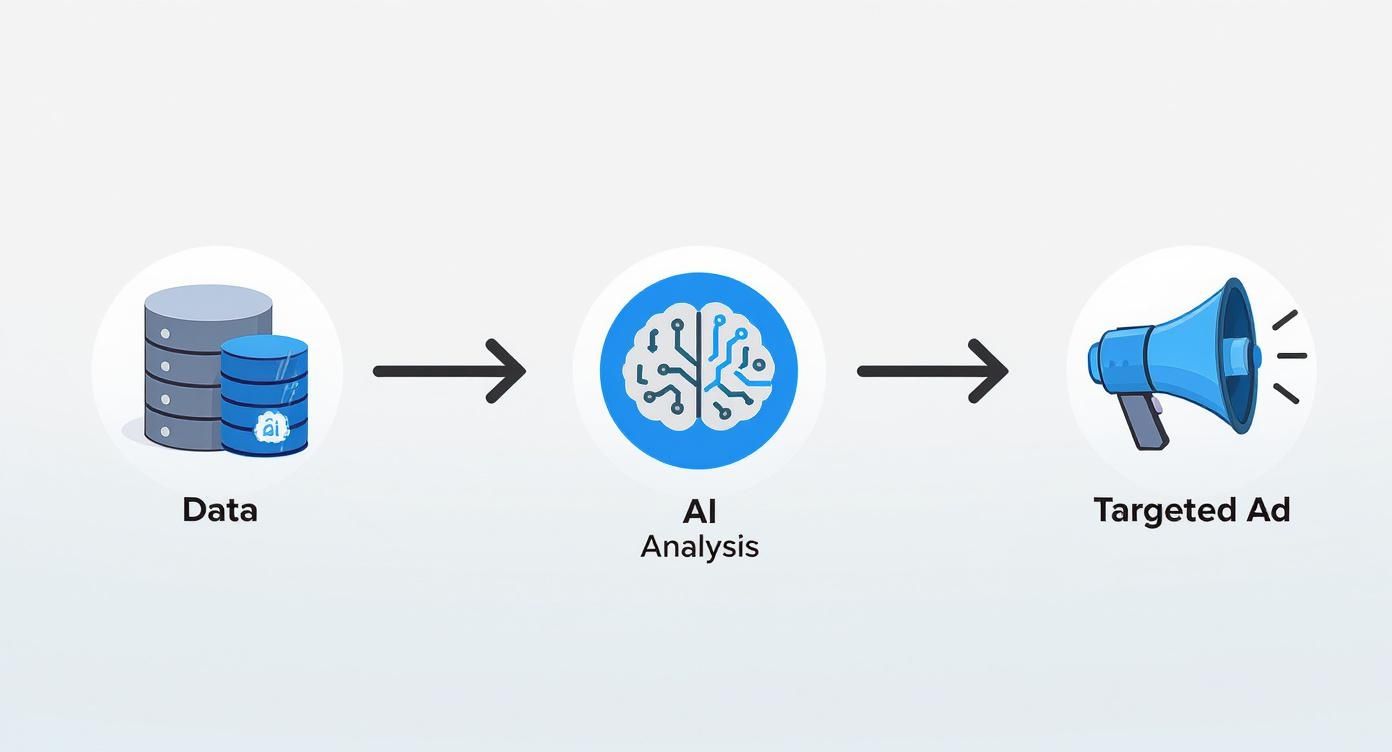
The flow is straightforward: data comes in, the AI finds important patterns, and a relevant ad goes out to the user.
To understand the difference, let's compare the old and new methods side-by-side.
This table shows that AI is a different approach to advertising. It prioritizes automation and intelligence over manual guesswork.
Why This Shift Matters
This move toward AI-driven advertising is part of a larger shift in marketing: the demand for personalized, data-backed experiences. Businesses are adopting AI because they must. Sticking to old methods means falling behind.
The numbers tell the story. The AI marketing market is projected to grow from 47.32 billion** in 2025 to over **107.5 billion by 2028. This growth, highlighted in recent AI marketing statistics on seo.com, shows how much companies rely on AI to analyze complex data and drive better results.
AI makes advertising smarter. It connects your message with the people most likely to convert. This improves both the user experience and your bottom line.
This fundamental change makes ai ads essential for any modern marketer. Letting smart algorithms handle difficult tasks gives you a level of targeting accuracy and efficiency that was once impossible.
Key Business Benefits of Using AI Ads
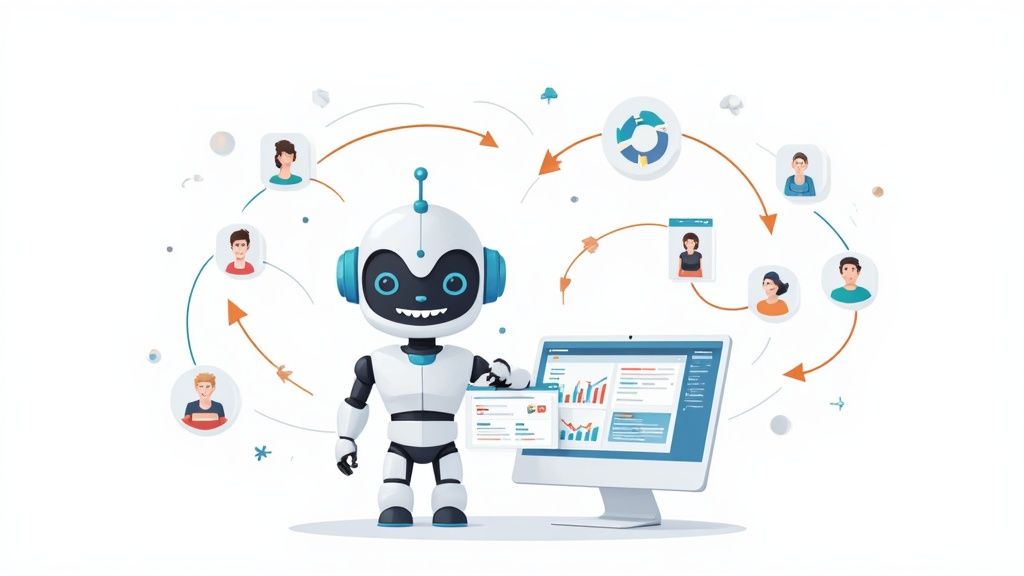
Moving from traditional ad buying to AI-powered campaigns is a fundamental shift that impacts your bottom line, frees up your team, and gives you a competitive edge. You are not just doing the same things faster; you are doing them smarter.
The most obvious benefit is superior targeting accuracy. AI algorithms process an incredible amount of data, including browsing habits, past purchases, and real-time behavior, far more than any human team could. This means your ads get in front of people who are looking for what you sell. This reduces the money you waste on audiences who will never convert.
When your targeting is that sharp, a higher return on investment (ROI) follows. Every dollar is spent more effectively because it is aimed at a high-potential customer.
Achieve True Ad Personalization
AI lets you deliver a unique ad experience to every person at scale. You no longer need to send a generic ad to a huge demographic. AI can change the ad copy, swap out images, or adjust the offer based on who is seeing it.
An e-commerce store could show a shopper an ad for the exact pair of sneakers they were just viewing. That kind of personalization makes a customer feel seen, builds brand loyalty, and makes them more likely to click "buy."
This smarter approach is why the market is growing. Valued at 6.7 billion** in 2023, the AI in advertising market is projected to hit **28.4 billion by 2033. You can review the numbers behind this rapid expansion on market.us.
AI helps you move from one-to-many communication to a one-to-one dialogue with your customers. This change builds stronger connections and drives more meaningful action.
Optimize Budgets and Save Time
Another advantage is automated budget optimization. AI ad platforms do not "set it and forget it." They constantly watch your campaign performance, shifting money away from what is not working and investing more in what is, all in real time. Your budget is always put to its best use.
This hands-off approach saves time and money:
- Automated Bidding: The AI handles the bidding process. It finds how to get you the best ad placements for the lowest cost.
- Reduced Manual Work: Your team can stop adjusting bids and budgets all day. They can focus on high-level strategy and creative ideas.
- Performance Forecasting: AI can predict how a campaign might perform. This gives you the confidence to make smarter budget decisions from the start.
By taking over these repetitive, data-intensive tasks, AI gives your team back its most valuable resource: time. You get better results without burning out your people. This lets you scale your ad efforts without constantly hiring.
The Tech Behind AI Ads
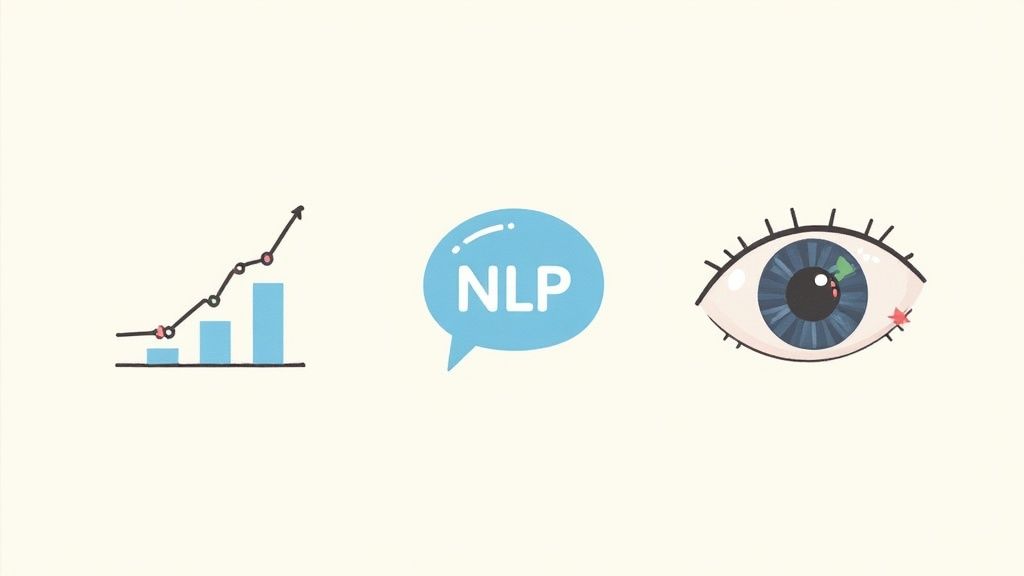
What makes AI ads so smart? It is a few core technologies working together. Think of it as a team of specialists. Each handles a different part of the puzzle, from analyzing numbers to understanding language and "seeing" images.
First is predictive analytics. This is the numbers expert. It analyzes your past campaign data, including clicks, conversions, and bounce rates. It uses that history to make educated guesses about what will happen next. In advertising, this means it can identify which users are most likely to buy something.
An online store might notice a pattern: people who buy running shoes often start looking at athletic socks about two weeks later. Predictive analytics flags this group. You can then stop showing sock ads to everyone and focus your budget on people who are ready to buy.
Teaching a Machine to Understand Language and Images
Next is Natural Language Processing (NLP). This is the technology that lets machines read, understand, and write like a human. It is important for ad copy.
NLP can scan thousands of customer reviews and social media comments to understand public sentiment. At the same time, it can generate dozens of different headlines and ad descriptions. It can then help test them to see which words connect best with a particular audience.
AI is not just about finding the right person to show an ad to. It is about figuring out what that ad should say and show to make them care.
Working with NLP is computer vision, which is the "eyes" of the AI. This technology lets the system interpret and understand images and videos. One of its important jobs is brand safety. It can analyze a webpage before placing your ad to make sure it does not appear next to inappropriate content.
It is also effective for contextual placement. A travel company’s AI could use computer vision to spot an article with photos of sunny beaches and then place an ad for a tropical vacation right there.
How It All Comes Together
These technologies do not work in isolation. They are constantly communicating to fine-tune every aspect of a campaign.
- Predictive analytics answers the "who" by finding your perfect audience.
- NLP figures out the "what" by creating the message that will stick.
- Computer vision handles the "where" by ensuring the ad appears in the right place.
This seamless integration allows AI to create ads that feel personal and perform well. To get a closer look at how these pieces fit together to build compelling campaigns, read our guide on ad creative AI. It explains how raw data becomes ads that connect with people.
How to Weave AI Into Your Ad Strategy
Starting with AI-powered advertising is a straightforward process. It begins with picking the right tools and knowing what you want to achieve. With a good plan, you can get AI working for you and start seeing a real impact without getting lost in technical details.
The first step is to choose an ad platform with strong, built-in AI. You do not need to build anything yourself. Platforms like Google Ads and Meta Ads have already done the difficult work, building AI features directly into their systems. They are good starting points because they handle the complex algorithms behind the scenes. This makes AI accessible even if you do not have a data scientist on your team.
Set Clear Goals and Get Your Data in Order
Before you launch a campaign, you need to define what success looks like for you. Are you seeking more website traffic? Higher conversion rates? A lower cost per acquisition? Your specific goals will guide the AI, telling it what to optimize for and which metrics matter most.
An AI is only as smart as the data you provide. If you give it messy data and vague goals, you will get poor results. Be clear about your objectives to give the algorithm a target.
Once your goals are set, check your data. This means making sure your website analytics and conversion tracking are set up correctly. Clean, accurate data is the fuel for effective AI ads. It allows the system to learn from actual user behavior and make smarter decisions about who sees your ads and when.
Below is an image of the Google Ads platform, where many advertisers build and manage these AI-driven campaigns every day.
Through interfaces like this, you can set up campaigns, define audiences, and tell the AI what success looks like so it can get to work.
Launch, Monitor, and Refine
With your platform selected and your data clean, you are ready to launch your first AI-driven campaign. Start small with a single product or service to keep the test focused. Use the platform’s automated features for bidding and audience targeting. Do not just "set it and forget it."
That is a common mistake. Human oversight is essential for getting the best results. You still need to watch the campaign’s performance and see how it is tracking against your key metrics. Watch which ad creatives the AI prioritizes and which audiences it finds most responsive.
- Review Performance Weekly: Check your campaigns at least once a week. Are you moving closer to your goals?
- Provide Feedback: If the AI starts targeting an audience segment that does not fit, step in and exclude it. This helps the algorithm learn and get smarter.
- Test and Adjust: The insights from your first AI campaign are valuable. Use what you learn to improve your next campaign and your overall strategy.
This blend of AI automation and human expertise is the key to success. To learn more about how AI can function as a partner, read our guide on AI marketing agents, which explores how these systems can take on complex marketing tasks. This collaborative approach ensures your AI ads not only hit their targets but also become more efficient over time.
Real Examples of Successful AI Ad Campaigns
https://www.youtube.com/embed/XKqNdX0qNRI
Seeing AI work in real situations makes its value clear. Companies in many industries use this technology to solve specific challenges and get tangible results. These examples show that AI is delivering value for businesses of all sizes.
The market for AI in marketing is growing, with projections hitting $40 billion by 2025. This growth is driven by industries like finance and retail, which are using AI to build better connections with their customers. You can find more details on these AI marketing trends on cubeo.ai.
Let's look at how a few brands are putting AI to work.
L'Oréal Masters Personalized Beauty
L'Oréal, the global beauty company, had a challenge. They wanted to connect with potential customers asking specific, complex questions about their skin, like “what is the best cream for facial dark spots?” Their old keyword strategy was not catching these high-intent, long-tail searches.
They turned to AI-driven search campaigns. This allowed them to match ads to the meaning behind these detailed questions, not just the exact keywords. The AI also adjusted ad creatives automatically to give people the answers they were looking for.
The results speak for themselves. L'Oréal saw a 2X higher conversion rate and cut its cost-per-conversion by 31%. It is a good example of how AI can understand the subtle needs of a customer.
MyConnect Reduces Customer Acquisition Costs
In Australia, the utility connection service MyConnect was using automated bidding and broad match keywords but wanted to improve campaign performance. Their goal was to get more leads without spending more money.
By using an AI-powered solution, they found new audience segments and fine-tuned their ad delivery. The AI discovered untapped search queries that were good at converting. MyConnect started reaching a new group of customers they had been missing.
The company saw a 16% increase in leads while paying 13% less for each one. A full 30% of these new conversions came from search terms the company had never targeted before.
This case shows how AI can find hidden opportunities and open new avenues for growth. For a closer look at how different brands build their strategies, review these marketing campaign examples.
These real-world applications of AI ads highlight the technology's flexibility. Whether you are trying to deliver a more personal experience or reduce your acquisition costs, AI offers a clear path to getting better results.
The table below gives a quick summary of how these companies used AI.
AI Ad Campaign Examples and Outcomes
Here is a snapshot of how real companies have used AI to improve their advertising and what they achieved.
As you can see, the application of AI is tailored to the specific business goal, leading to improvements in key performance metrics.
Common Questions About AI Ads
As advertisers start using AI, a few questions always come up. Understanding these key points will help you approach AI ads with more confidence. Let's clear up some common uncertainties.
What Is the Difference Between Programmatic and AI Ads?
This is a common question. It is easy to confuse programmatic advertising and AI ads, but they are different parts of the process.
Programmatic advertising automates the buying and selling of ad space. It is a fast, automated auction for digital ad placements across the internet. It handles the mechanics.
AI ads take things a step further. While they often rely on programmatic systems to place the ads, their real job is to use machine learning to make the campaign smarter. The AI constantly analyzes data to predict what will work, personalize the ad creative, and adjust bidding strategies in real time.
Think of it this way: programmatic is the fast car that delivers your ads. AI is the expert driver, making split-second decisions to get you to your destination more efficiently. You can have a programmatic campaign without sophisticated AI, but most top-tier AI ad platforms use programmatic buying to execute their intelligent strategies.
How Much Data Do You Need for AI Ads to Work?
This is an important question, especially for smaller businesses. The performance of any AI-driven campaign depends on the data you provide. The more clean, relevant data the system has, the better it gets at spotting patterns and making smart predictions.
The good news is you do not need a huge amount of data to get started.
Most major AI ad platforms, like those from Google and Meta, are designed to start learning with modest amounts of information. They can begin by analyzing your initial website traffic, a customer email list, and how people interact with your first few ads.
From there, the AI keeps learning. As your campaigns run, it gathers more performance data, refining its models with every click and conversion.
A good benchmark to aim for is having accurate conversion tracking set up. Once you have at least 50-100 conversions, an AI model has enough information to understand what resonates with your audience and drives results.
Can AI Completely Replace Human Advertisers?
I hear this concern often, but the simple answer is no. AI is here to empower human experts, not make them obsolete.
AI is excellent at processing massive amounts of data, identifying trends humans would miss, and automating tedious tasks. It can optimize millions of bids or test thousands of ad variations around the clock without getting tired. No human team can do that.
But human oversight is still critical. Here’s why:
- Strategic Direction: A human sets the vision. We define the business goals, identify the target audience, and create the campaign's core message. The AI is good at executing a strategy, but it cannot create one from scratch.
- Creative Intuition: AI can generate ad copy and suggest images, but it lacks a true understanding of culture, humor, and the emotional spark that makes an ad memorable. The best creative still comes from human insight.
- Ethical Oversight: We are the guardians of the brand. Humans are responsible for making sure campaigns are ethical, follow regulations, and do not stray from brand values. This includes tasks like preventing bias and ensuring ads do not appear in the wrong places.
The best way to think about it is like a pilot and an autopilot. The autopilot is great for handling the routine parts of a flight, making constant, minor adjustments. But the pilot is always in command, ready to take control in a storm and responsible for setting the final destination.
The future of advertising is not man versus machine; it is man with machine. The best results come from blending the efficiency of AI with the strategic, creative, and ethical guidance of a human expert.
Ready to grow your app with a strategy that combines human expertise with AI precision? Adworkly specializes in helping apps achieve viral growth through smart performance marketing, ASO, and authentic user engagement. Find out how we can help you hit your goals and improve your ROI. Learn more at adworkly.co