
 UGC Infra
How to Find UGC Creators for Your App Marketing Campaigns
Discover how to find UGC creators who can elevate your app campaigns. Learn proven strategies for sourcing, vetting, and partnering with authentic creators.
Let's be honest: in a ridiculously crowded app store, slick, polished ads just don't cut it anymore. Your biggest advantage isn't a bigger ad budget; it's authenticity. This is where user-generated content (UGC) comes in, giving you a direct line to the people you actually want to reach.
We're not just talking about marketing fluff here. We're talking about real, measurable results that can completely change your app's growth story.
For app founders, a smart UGC strategy is the most direct path to hitting those crucial KPIs. We’re talking about a lower Cost Per Acquisition (CPA) and a serious bump in conversion rates. Why does it work so well? Because your target audience, especially Gen Z and Millennials, has been trained to scroll right past corporate-speak. They’re looking for content from real people, and they trust it implicitly.
The Psychology: Why We Trust Strangers on the Internet
The magic of UGC is pretty simple when you break it down. We're wired to trust recommendations from people we see as our peers far more than we trust a faceless brand telling us how great they are.
When a potential user sees someone they can relate to genuinely loving your app, it creates an immediate sense of social proof. That peer-to-peer validation feels genuine, instantly making them more likely to give your app a shot.
This is exactly why UGC crushes it in paid ad campaigns. A raw, unedited video from a creator will almost always outperform a glossy, high-budget production. It feels native to the platform, it stops the scroll, and that authenticity translates directly into better performance.
I’ve seen it time and time again: UGC-based ads can pull in a 4x higher click-through rate and slash the cost-per-click by 50% compared to traditional ads. It's proof that being real directly leads to a more efficient ad spend.
Building a Flywheel for Growth
UGC is about more than just a quick win on your ad campaigns. It’s about building a sustainable, long-term growth engine for your app.
Think of it as a flywheel: Happy users create great content, which pulls in new users. Those new users fall in love with your app and start creating content of their own, and the cycle continues. Over time, this powerful loop lessens your dependency on paid ads and helps you build a loyal community that grows on its own.
The market backs this up. The global UGC space is expected to explode from 5.36 billion to 32.6 billion by 2030. This isn't a fleeting trend; it’s a fundamental shift in how brands have to connect with their customers.
Even platforms like Reddit are becoming treasure troves. I've seen founders dig through subreddits to find raw, unfiltered app feedback, and those insights can lead to changes that boost return visits by 20%. If you want to dive deeper into the numbers, you can explore more user-generated content statistics on amraandelma.com. This all points to one thing: finding the right creators is key to driving both acquisition and long-term retention.
Where to Find Authentic UGC Creators
Finding the right creators isn't about luck; it’s about knowing exactly where to look. Your goal is to find real people who can create content that feels completely at home on the platforms your audience already uses and loves. This means ditching generic searches and getting tactical.
The hunt often starts on TikTok, where raw, user-generated content is king. In fact, studies have shown that UGC on TikTok is 22% more effective than typical branded content, driving the kind of authentic engagement that can seriously bring down your customer acquisition costs.
Mastering Social Media Sourcing
Your best future brand advocates are already out there making content. You just need to find them. The trick is to think like your target user and search for the hashtags, keywords, and conversations they’re already a part of.
Instead of casting a wide net, get specific.
- Hashtag Deep Dive: Go beyond the obvious. Start with broad tags like
#ugccreatoror#ugccontent, but then drill down by adding your niche. Think#fitnessappugc,#productivitytok, or#indiegameugc. - Competitor Recon: Poke around your competitors' tagged posts and mentions. You’ll often find experienced creators who already know your space and are talking to the audience you want to reach.
- Problem-Solving Searches: Use the search bar on TikTok and Instagram to find people discussing problems your app solves. Search for phrases like "best app for budgeting" or "how I plan my week" to uncover organic conversations and potential creators.
Creator Marketplaces and Discovery Tools
While scrolling through social feeds works, it can eat up a lot of time. Creator marketplaces and AI-powered discovery platforms are built to speed this up, helping you build a pipeline of potential partners much more efficiently.
Think of these platforms as a bridge connecting brands and creators. They let you filter by niche, audience demographics, engagement rates, and portfolio examples. Many also handle the annoying administrative stuff like contracts and payments. If you're just starting, browsing the kinds of UGC creator jobs on these sites can give you a great feel for the market.
Key Takeaway: The goal isn't just to find any creator. It's to find the right one whose style and audience are a perfect match for your app. A smaller, super-engaged following is almost always more valuable than a massive, passive one.
This is why UGC is so powerful. It directly impacts the metrics that matter most to an app founder.
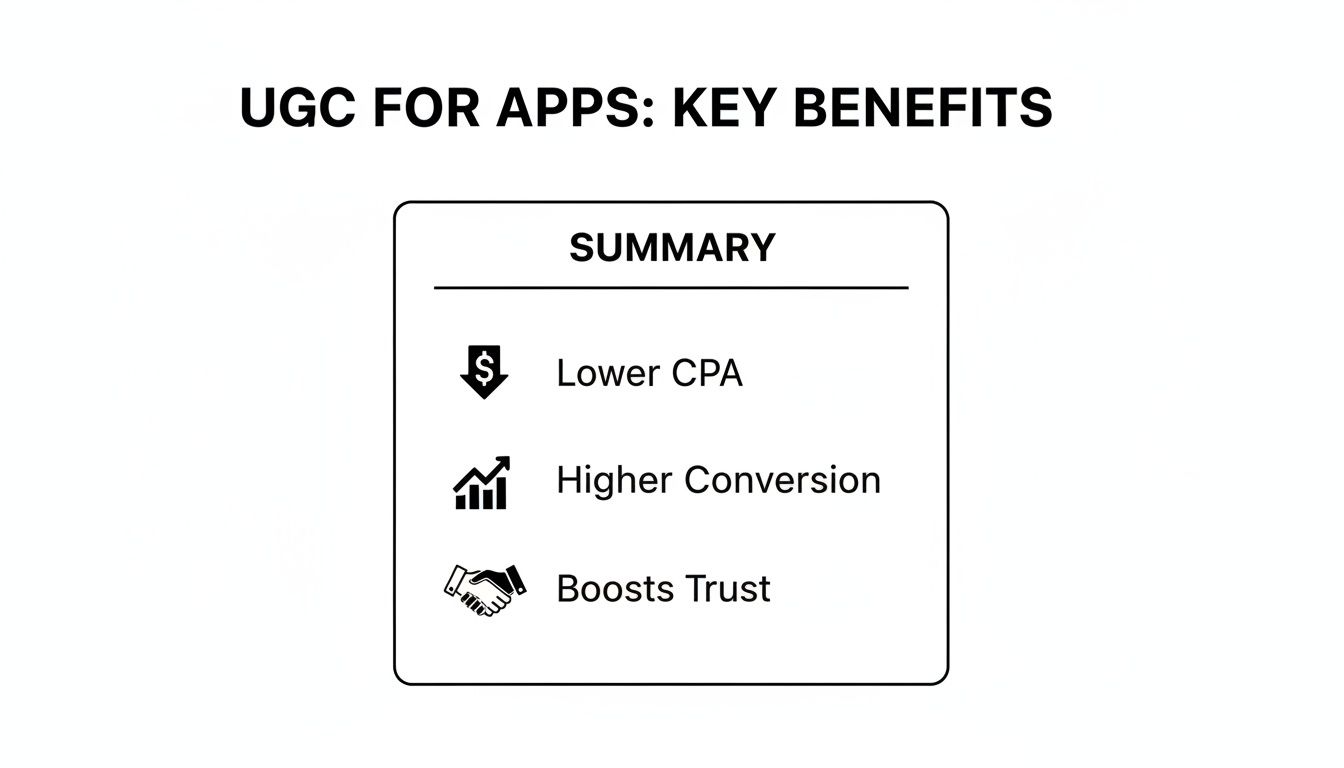
From lower acquisition costs to higher conversions, these benefits all stem from the trust that only authentic, human content can build.
Diving Into Niche Communities
Don't sleep on platforms like Reddit. Subreddits dedicated to your app’s category, whether it's r/iosgaming, r/getdisciplined, or r/budgetfood, are absolute goldmines for finding genuine fans.
These users are passionate, knowledgeable, and already creating detailed reviews, tutorials, and recommendations. Engage with them authentically. Jump into discussions, answer questions, and keep an eye out for users who are already praising your app or similar products. These people make the most compelling creators because their enthusiasm is 100% real.
To help you decide where to focus your energy, here’s a quick breakdown of the most common hunting grounds.
Platform Breakdown for Finding UGC Creators
Ultimately, a mix-and-match approach often works best. You might find a polished pro on a marketplace and an enthusiastic super-fan on Reddit, and both could be invaluable to your strategy.
How to Properly Vet and Select Creators

You’ve got a list of potential creators. Great. But sourcing is the easy part; choosing the right partners is where your campaign will either succeed or fail. It’s so easy to get dazzled by a huge follower count, but trust me, that’s almost always a vanity metric. The real gold is finding a creator who genuinely connects with an audience that looks just like your ideal app user.
Think of the vetting process as your quality control checkpoint. This is where you filter out the mismatches and pinpoint the creators who can make content that doesn't just look authentic but actually inspires people to hit that download button. A solid partnership always starts with a deep dive into their past work and audience connection.
Look Beyond the Follower Count
I'd take a creator with 10,000 highly engaged, niche-perfect followers over one with 100,000 passive ones any day of the week. Forget the raw numbers and focus on the quality of their engagement. Scroll through their comments. Are people having real conversations, or is it just a wall of fire emojis and "nice pic" spam?
Meaningful dialogue in the comments is a dead giveaway that the creator has built a real, trusting community. And that’s the kind of audience that will actually listen when they recommend your app.
A crucial part of your vetting process should be analyzing the comment-to-like ratio. A high number of genuine comments relative to likes often indicates a creator has built a real community, not just an audience.
Also, keep an eye out for creators who actually reply to their comments. It shows they’re invested in their community, which is a trait that usually carries over into their brand partnerships.
Analyze Their Content and Authenticity
Go through a creator’s feed with a critical eye. Does their content style, the editing, the tone, the overall vibe, actually fit your app's brand? Even more important, does their content feel real, or does their feed look like one long, scrolling billboard of sponsored posts?
You're looking for someone whose endorsement will feel less like an ad and more like a recommendation from a trusted friend. A creator who’s hawking a different product every other day is a red flag. Their audience is likely numb to ads, which means your message will fall on deaf ears.
Creator Vetting Checklist:
- Content Alignment: Do their video style and tone match your brand? A creator known for chaotic, fast-paced comedy might not be the best fit for a mindfulness app, for example.
- Audience Demographics: Don't be shy about asking for a screenshot of their audience analytics. You need to see if their followers' age, gender, and location line up with your target user.
- Past Performance: Check out their previous sponsored posts. Did they get good engagement? More importantly, did the ad feel natural and true to their personal brand?
- Professionalism: How are they to work with from the jump? Prompt, clear communication during your first few emails is a fantastic sign of a reliable partner.
This methodical approach is how you turn a long list of names into a powerful shortlist of perfect-fit partners. Spending the time to vet creators properly is the single best investment you can make to avoid wasting your budget and ensure you’re building partnerships that will actually move the needle.
Crafting Your Outreach to Build Real Partnerships

Alright, you've got a solid shortlist of creators who look like a great fit. Now comes the moment of truth: the first message. This is where so many brands get it wrong.
A generic, copy-paste DM is the fastest way to get your message buried and ignored. Your goal here isn't just to commission a video; it's to start a real conversation with someone who could become a powerful ambassador for your app.
Effective outreach all comes down to personalization. You need to show you’ve actually looked at their work. Mention a specific video of theirs you liked and explain why it resonated with you. That one small detail instantly sets you apart from the dozens of other brands just spamming their inbox with vague offers.
Personalizing Your First Message
Your initial message, whether it's a DM or an email, needs to be concise, respectful, and focused on the value for them. Make it incredibly easy for the creator to see the opportunity and say yes to a conversation.
Here’s a simple framework I’ve seen work time and time again:
- Lead with a real compliment. Don’t just say "love your content." Be specific. "Hey [Name], I loved your recent video on productivity hacks. The editing was so snappy and engaging."
- Quickly introduce yourself. A brief "I'm [Your Name] from [App Name]" is all you need.
- Get to the point. Tell them you're looking for talented creators to partner with and you think their style would be a perfect match for your brand.
- Propose a clear next step. Keep it low-friction. Something like, "Are you open to paid collaborations? If so, I'd love to send over more details via email." works perfectly.
This approach shows you respect their craft and their time. It frames the conversation as a potential partnership from the get-go, not just another gig. You can dive deeper into the nuances of working with a UGC creator in our detailed guide.
Navigating Negotiation and Compensation
Once a creator responds with interest, the conversation will naturally turn to deliverables and payment. Being transparent and prepared for this discussion is crucial for building a relationship on solid ground. Don’t be cagey about your budget. It just creates friction and distrust.
Don't treat negotiation like a battle to be won. Think of it as a collaborative effort to find a win-win arrangement where both you and the creator feel the partnership is fair and valued. That mindset is the foundation of any good long-term relationship.
There are a few standard ways to structure compensation in the UGC world. The best model often depends on your campaign goals and what the creator is comfortable with.
Common Compensation Models
- Flat Fee: This is the most common and straightforward approach. You agree on a fixed price for a set number of videos or images. It’s clean, simple, and everyone knows where they stand.
- Performance-Based: This model ties payment to specific outcomes, like app installs or sign-ups tracked with a unique link. It can be a great incentive but often works best when paired with a guaranteed base fee to respect the creator's time.
- Product Gifting (Product-for-Post): Offering free premium access or merchandise can sometimes work, especially with micro-creators or true fans of your product. But remember, content creation is their job, so you should always be prepared to offer monetary compensation as the primary option.
Instagram continues to be a hotbed for finding great UGC creators, and the data backs it up. Posts featuring UGC get 70% more engagement than standard brand posts, which just goes to show how much audiences crave that authentic touch. Make sure you also discuss content usage rights upfront. Clarifying where and for how long you plan to use their content is a non-negotiable step to avoid headaches down the line.
Writing a Campaign Brief That Inspires Great Content
So, you've found the perfect creators. Don't stumble at the next hurdle. A clear, inspiring campaign brief is the absolute bedrock of a successful partnership. It's what separates generic, unusable content from videos that feel authentic and actually move the needle.
Think of your brief less like a strict set of rules and more like a friendly guide. You need to give creators enough direction to hit your goals, but enough creative freedom to do what you hired them for. A brief that’s too restrictive will just suffocate their natural style, and you'll end up with content that feels forced and falls flat.
The Core Elements of a Winning Brief
Your brief should be the single source of truth for the entire campaign, answering every question a creator might have before they even ask. Keep it concise, scannable, and easy to digest.
First, get straight to the point with your campaign objectives. Are you trying to drive app installs? Boost brand awareness? Or are you pushing a specific new feature? This context is crucial; it helps the creator frame their content with your end goal in mind, which is key to getting UGC that delivers on your KPIs.
Next, nail down your key messaging. What’s the one thing the audience must take away from the video? Ditch the marketing jargon. For example, instead of saying, "Our app optimizes caloric intake through AI," just say, "Our app makes tracking your meals dead simple."
A great brief provides guardrails, not a cage. It tells the creator where the finish line is (the objective) but lets them choose their own path to get there (the creative). That's the balance that produces content that performs.
Structuring Your Deliverables and Guidelines
Once you've covered the why and the what, it's time to get into the specifics. This part has to be crystal clear to avoid the dreaded, time-wasting back-and-forth.
Lay out the content deliverables precisely. How many videos do you need? What's the required length (e.g., one 15-30 second video)? What are the platform specs (e.g., 9:16 for TikTok/Reels)? Then, give them a clear Call to Action (CTA). Tell the creator exactly what you want the viewer to do, something direct like, "Download our app from the link in my bio!"
Finally, a simple list of Dos and Don'ts works wonders. This is where you can set creative boundaries without micromanaging them.
- Do: Show the app's home screen within the first three seconds.
- Do: Say our brand name out loud.
- Don't: Show any competitor logos or products.
- Don't: Use copyrighted music.
With this framework in place, the rest of the onboarding process, from signing agreements to getting them app access, should be a breeze. A professional, organized experience starts the partnership off on the right foot, making creators feel valued and excited to produce content that truly shines.
Measuring the Impact of Your UGC Campaigns
Look, launching a UGC campaign without a way to track it is just burning cash. You’re throwing money at creators, hoping for the best, but you have no idea if it’s actually moving the needle. You absolutely have to connect your efforts back to real business results to know what's working and justify the spend.
It’s easy to get distracted by vanity metrics like views and likes. Sure, they feel good, but they don't pay the bills. The real question is whether a creator's video is driving downloads, sign-ups, or in-app purchases. That’s the clarity you need.
Defining Your Core KPIs
Before you even think about dashboards or data, you have to decide what success actually looks like for this specific campaign. Your main KPIs have to tie directly back to your original goals.
For most app founders I talk to, it boils down to a few critical metrics:
- Click-Through Rate (CTR): This is your first signal. How many people actually clicked the link in the creator’s post? A high CTR tells you the creative is grabbing attention and the call-to-action is working.
- Cost Per Install (CPI): This is the bottom line for user acquisition. It shows you exactly what you paid to get one new user from that creator’s content. No ambiguity here.
- Return on Ad Spend (ROAS): If you're boosting the UGC as a paid ad, ROAS tells you how much money you made for every dollar you spent. Anything over 1.0 means you're in the green.
Focusing on these performance metrics helps you quickly separate the creators who make nice-looking content from the ones who actually drive growth. To get a much deeper understanding of these numbers, you can explore our full guide on TikTok creator analytics.
Setting Up for Accurate Attribution
If you can’t measure it, you can’t manage it. Solid attribution is non-negotiable for figuring out which creators and which specific videos are bringing in the results. Otherwise, you’re just guessing.
The simplest, most effective way to track performance is by giving each creator a unique asset to share. This creates a clean, traceable line from their content straight to an action inside your app.
Always set up unique tracking links for every single creator. Tools like Bitly or your app’s mobile measurement partner (MMP) make this easy. This is the only way to know for sure who is driving installs and who isn't.
Another great tactic is to use creator-specific promo codes. Something like "JESSICA20" gives you a direct link to every purchase or sign-up she drove. This not only makes tracking dead simple but also gives their audience an extra little push to convert.
Once that data starts coming in, your top performers will become obvious. These are the creators you want to build real, long-term partnerships with. Double down on what works, repurpose their best-performing content in your paid ad campaigns, and even feature it on your app store page. This is how you scale a UGC program from a handful of one-offs into a predictable growth channel.
Common Questions About UGC
Diving into creator partnerships for the first time? It's natural to have a few questions. Let's tackle some of the most common ones we get from app founders just starting out.
How Much Should I Pay a UGC Creator?
There’s no magic number here. Creator rates are all over the map, depending on their experience, what you're asking them to create, and how you plan to use the content.
You might find a new creator who's just building their portfolio and charges 150 to 500 for a video. On the other hand, a seasoned pro with a history of creating top-performing ads will command a much higher rate. Some creators might even be open to a product-only deal if they’re genuinely excited about your app. The best approach is to set your budget first, then go into negotiations with a clear idea of what you can offer.
What’s the Difference Between a UGC Creator and an Influencer?
The main distinction comes down to their primary function. A UGC creator is a content specialist. You hire them to produce authentic-looking videos and images that your brand will use on its own channels, think paid ads, your website, or your social media feeds. Their job is to create the assets.
An influencer, however, is a distribution channel. Their value lies in their established audience and the trust they've built. You're paying to get your app in front of their followers on their social media accounts. While many influencers can create great UGC, their core service is promotion to their community.
Key Takeaway: Think of it this way: with UGC creators, you're buying content. With influencers, you're renting an audience.
How Many Creators Should I Start With?
For your first campaign, don't try to boil the ocean. Start small.
Kicking things off with a tight-knit group of 3 to 5 creators is the sweet spot. It's manageable enough that you won't get overwhelmed, but it gives you enough content variety to see what actually works.
This initial test run allows you to gather real performance data. You'll quickly learn which creator styles and messaging hooks connect with your target users. Once you’ve found a winning formula, then you can confidently put more budget behind it and bring on more creators who fit that successful profile.
Ready to scale your app's growth with authentic, high-performing content? Adworkly combines AI-powered strategy with expert execution to build creator-led campaigns that drive measurable results. Learn how we can help you find the right creators and build a UGC engine that gets your app on autopilot at https://adworkly.co.